Choosing a home builder means entrusting someone with the task of transforming a vacant lot into a living space. The problem is that most selection criteria look similar from one guide to another: reputation, quotes, guarantees. These points matter, but they are not enough to differentiate two builders who check the same boxes on paper.
Carbon impact of materials: the criterion that few future homeowners check
Since the tightening of the RE2020 applicable for the 2025-2027 period, a home builder is no longer judged solely on the energy consumption of the finished building. The carbon impact of construction materials is now part of the regulatory evaluation. Low-carbon concrete, wooden structures, bio-sourced materials: the solutions chosen by the builder directly influence the project’s compliance.
Why is this point useful when making comparisons? Because a builder who has not yet integrated these requirements into their current practices may discover the issue at the time of the building permit application. Administrative back-and-forth can prolong the project and may alter the budget.
Since September 2026, performance data for new buildings has been available in open data, including for individual homes. You can therefore ask each builder to provide you with concrete results on their recent projects and compare them to this public data. A professional who refuses or sidesteps this topic deserves increased scrutiny.
To explore house models designed within this regulatory framework, you can visit the Maisons Euro France website and compare the construction approaches offered.

CCMI and delivery guarantee: what the contract really protects
The individual home construction contract (CCMI) appears in all guides, and rightly so. The delivery guarantee is a central protection of this system.
Specifically, the delivery guarantee covers two situations:
- The builder goes bankrupt during the project. A guarantor steps in to complete the work at no additional cost to you.
- The builder exceeds the agreed deadlines. Delay penalties apply, governed by the contract and the law.
- Defects appear upon delivery. The guarantee requires the builder to correct them before you take possession of the property.
Before signing, check that the name of the guarantor is explicitly stated in the CCMI. Also, request proof of the construction damage insurance. No named guarantor in the contract, no signature.
Construction quotes: reading between the lines
A global quote that displays an attractive price says nothing about the distribution of costs. Two builders can propose a similar amount for very different services.
Items to compare line by line
The foundations, framework, insulation, exterior joinery, and heating system represent the backbone of the budget. A detailed quote item by item allows you to spot where a builder cuts corners on quality. If the quote groups everything under a “major works” line without detail, ask for a breakdown.
Fees that the quote sometimes overlooks
Connection to networks, soil study, land boundary fees, or development tax do not always appear in the initial quote. A transparent builder mentions them from the first estimate, even in the form of an approximation. One who keeps them silent will reserve surprises for you halfway through the project.
PTZ and new construction: a financing lever to integrate early
Since April 1, 2025, the zero-interest loan again finances the construction of new individual homes across the country, including in zones B2 and C. The program runs until December 31, 2027.
This return of the PTZ changes the game in choosing a builder. Why? Because the financial setup requires precise documents: RE2020 certificate, standardized technical description, projected work schedule. A builder accustomed to preparing these files saves you several weeks on fund release.
Conversely, a builder unfamiliar with the PTZ may delay your loan application or even jeopardize your eligibility if the documents provided do not meet banking requirements. Ask the question at the first meeting: how many PTZ files have you assisted with this year?
Ongoing site visit: the most reliable trust test
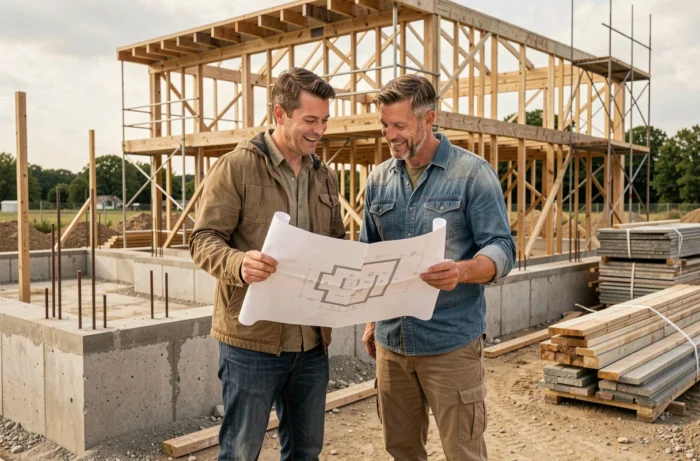
Photos of delivered houses on a website are showcases. The reality of a builder is seen on an active site. Ask to visit one or two ongoing projects. The state of an active site reveals the level of organization of the builder.
- A clean site, with materials stored safely and clear circulation areas, indicates rigorous oversight.
- The presence of an identifiable site manager on-site shows that the builder is not subcontracting coordination.
- Adherence to the displayed schedule (or a clear explanation of a delay) gives an indication of the reliability of the announced deadlines.
If the builder refuses the visit or systematically postpones the date, it’s a signal. A professional confident in their work has no reason to hide their sites.
Choosing a builder relies on concrete checks: compliance with RE2020, solidity of the CCMI, transparency of the quote, ability to manage the PTZ, actual state of the sites. Each of these points should be verified before signing. After that, it’s too late to change your mind without heavy financial consequences.