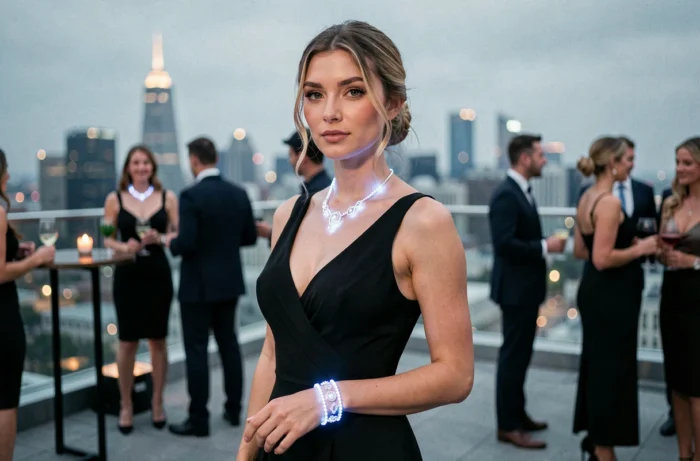
LED light-up jewelry refers to any accessory worn on the body (bracelet, necklace, earrings, ring) that incorporates one or more light-emitting diodes powered by a button cell battery. Their light comes from a semiconductor that converts electrical current into visible photons, without notable heat. This technical characteristic distinguishes them from single-use chemical fluorescent bracelets, whose light results from a time-limited chemiluminescent reaction.
LED or chemical fluorescent: two technologies not to be confused
The confusion between LED jewelry and fluorescent sticks (often called “fluoro bracelets”) remains common. Both produce light, but their operation and lifespan have nothing in common.
A chemical fluoro bracelet contains two liquids separated by a fragile wall. When bending the stick, the wall breaks, the liquids mix, and the chemical reaction produces luminescence that lasts for a few hours before extinguishing permanently. The fluoro bracelet is a single-use consumable.
An LED jewelry piece operates thanks to a replaceable or rechargeable button cell battery. The diode can light up, blink, or change color depending on the integrated circuit. As long as the battery provides current, the jewelry remains functional. Some models offer multiple light modes (steady, slow pulse, fast blink) controlled by a micro-switch.
For those organizing an event, the difference translates into practical terms: fluoro bracelets are suitable for a low-cost mass effect, while LED jewelry serves as reusable accessories for recurring events. Those who want to learn everything about light-up jewelry will find a detailed overview of the available formats on the market.
Button cell battery and European regulations: what sellers often overlook
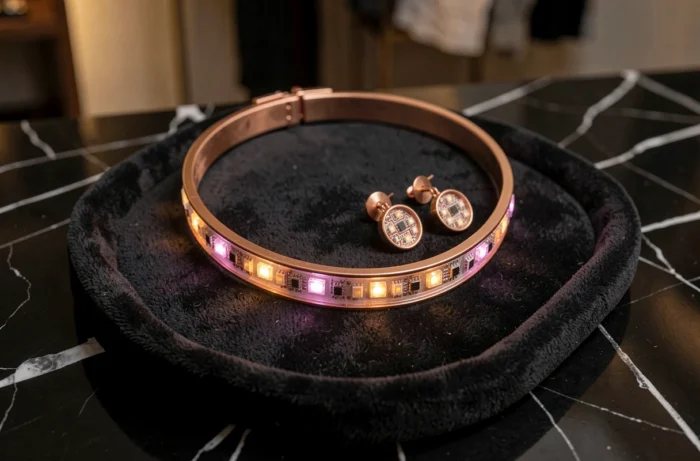
Most articles on light-up jewelry limit themselves to describing colors and visual effects. The issue of the integrated button cell battery deserves particular attention, especially from a regulatory standpoint.
Battery labeling requirements will evolve in 2026 and 2027 within the European Union. Manufacturers and importers must clearly identify the product, provide relevant warnings, and ensure traceability, including for sellers based outside the EU.
The extended producer responsibility (EPR) applies to batteries integrated into LED jewelry. This obligation goes beyond simply stating “battery included” on the packaging: it concerns collection and treatment at the end of life.
A particularly sensitive point concerns light-up jewelry intended for children. Models resembling toys must be evaluated based on their foreseeable use. Easily accessible button cell batteries pose a recognized ingestion risk, which imposes enhanced design requirements (secure compartment, closure screws).
Criteria to check before purchasing LED jewelry
- Presence of the CE marking and identification of the responsible manufacturer or importer within European territory
- Battery compartment secured by a screw if the jewelry is accessible to a child under 14 years old
- Clear indication of the type of battery used (CR2032, LR44, or other) to facilitate replacement
- Statement of compliance with restrictions on chemical substances (RoHS) for electronic components
The replaceability of the battery will become an increasingly regulated design criterion. Repairable LED jewelry will gain an advantage over sealed disposable models, both from a regulatory perspective and in terms of sustainability.
LED jewelry for events: choosing the right shape for the occasion
The format of the light-up jewelry determines its visual effect and wearing comfort. Each type responds to a different context.
Silicone LED bracelets remain the most common format for events. Flexible, lightweight, and shock-resistant, they can be worn for several hours without discomfort. Their surface allows for printing a logo or message, making them a popular medium for corporate events or weddings.
LED earrings draw attention to the face and work well in dark environments (club, dance floor, concert). Their weight depends on the battery casing: the most comfortable models use a magnetic clip rather than a classic hook.
Light-up necklaces and LED pendants create a focal point at the bust. They are suitable for evening wear as they replace a classic piece of jewelry while adding an extra visual dimension. Some models combine optical fibers and micro-LEDs for a diffused halo effect.
Adapting the choice to the type of event
- Wedding or gala: favor necklaces or earrings with warm white light, steady, that integrate into a formal outfit without a “gadget” effect
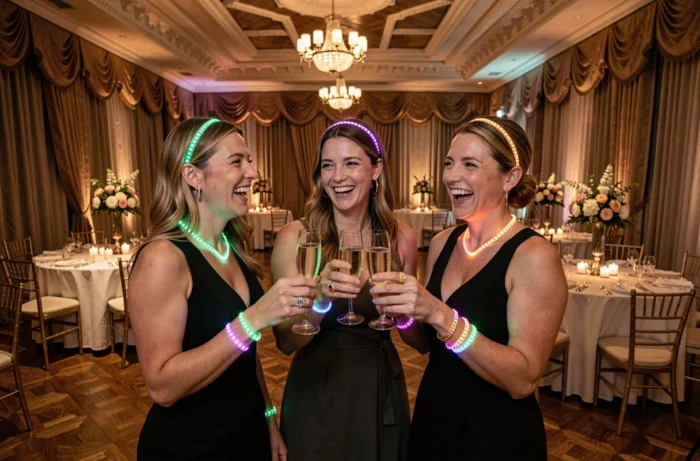
- Fluoro party or festival: opt for multicolored bracelets and rings with fast blinking for a mass effect on the dance floor
- Birthday or private party: distribute personalized LED bracelets as reusable souvenirs rather than disposable chemical fluoro bracelets
- Children’s event: choose models compliant with toy standards with a secure battery compartment
Longevity and maintenance of LED light-up jewelry
The longevity of LED jewelry depends on three factors: the battery capacity, the lighting mode used, and the quality of the circuit.
In blinking mode, the consumption is significantly lower than in steady mode. An LED jewelry piece in pulse mode consumes less than in continuous lighting, which significantly extends the battery life of the same button cell.
Maintenance is limited to a few precautions. Water and sweat can oxidize the metal contacts of the battery compartment. Removing the battery after each use prolongs the life of the circuit. Silicone models can be cleaned with warm soapy water, while metal components prefer a dry wipe.
Replacing the battery remains the main maintenance action. On well-designed models, the operation takes a few seconds with a small screwdriver. Jewelry with sealed batteries ends up in the trash once the battery is exhausted, a consumption model that European regulations tend to discourage.
LED light-up jewelry combines simple technology with a strong visual impact at events. The real selection criterion goes beyond color or price: the quality of the battery compartment, regulatory compliance, and the possibility of replacing the battery determine whether the accessory will be used once or accompany dozens of events.