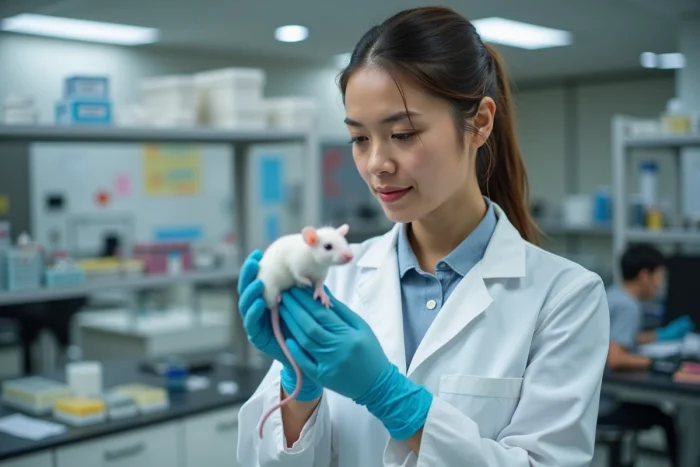
The European regulation has prohibited the marketing of cosmetics tested on animals since 2013, but several international markets, including China, still require these tests for certain imported products. Some brands circumvent these constraints through exceptions or local partnerships, blurring the lines of an already complex legislation.
At Dior, the official communication asserts strict compliance with European legislation, while acknowledging the need for adaptations to access certain foreign markets. This position raises questions about the real scope of commitments and the transparency of testing practices and alternatives.
Animal Testing in the Cosmetic Industry: Understanding the Issues and Current Practices
The debate over animal testing in cosmetic products has not died down with the legislation. Since 2013, the European Union has put an end to the manufacture and marketing of cosmetics tested on animals, whether for ingredients or final formulas. This development, enshrined in Regulation (EC) No. 1223/2009, has disrupted the industry.
Alternatives have gradually taken hold: in vitro testing, simulation software, procedures validated by the European Centre for the Validation of Alternative Methods. The principle of the 3Rs now structures research: reduce the number of animals used, replace whenever possible, and refine methods to limit animal distress. Some associations, like GRAAL, even work towards the rehabilitation of laboratory animals, proving that changes are happening concretely.
However, not everything is so simple. The REACH regulation provides for certain exemptions for chemical substances and still allows, under conditions, animal experimentation. It is therefore impossible to assert that no cosmetic circulating in Europe owes anything to these tests, as regulatory paths intertwine.
France applies the rule uncompromisingly. Elsewhere, the situation is evolving slowly: China has eased its requirements since 2021, while still retaining the possibility of imposing tests depending on the product category or its mode of entry into the territory. Progress is also being made in India, Norway, and Canada, but the global map of cruelty-free beauty remains heterogeneous.
In Europe, the DGCCRF prohibits indicating “not tested on animals” on packaging: this is a given for everyone, and there is no need to make it an argument. Therefore, consumers only have the regulation as a reference; everything else falls under declaration or communication. For those who want a precise overview of the situation at the Dior brand, find a complete update here: animal testing at Dior.
Dior Facing the Cruelty-Free Question: What Progress and What Gray Areas?
The Dior group presents flawless compliance with European law: no animal testing on finished products or ingredients for the European market. The Christian Dior perfumes and cosmetics are officially aligned with this requirement, symbolizing an acknowledged expertise and a claimed modernity.
But what about beyond the continent? The brand is absent from official cruelty-free lists and has no certification from independent organizations like PETA. This absence is not a detail: it reveals the difficulty of guaranteeing a uniform policy on a global scale. A concrete example: China can still impose tests on imported cosmetics, depending on the product category. The same care, signed by Dior, can thus follow a strictly non-testing path in Europe but be subject to other requirements elsewhere. The boundary, often invisible to the buyer, does exist.
In this context, it is difficult to decipher the commitments of major houses. Product sheets and official pages display legal compliance but do not venture into global guarantees or specific partnerships with NGOs. However, the demand for clarity continues to grow. Customers and associations are calling for explanations about the true origin of products and the adoption of proven alternatives. The industry is moving forward, but in fits and starts.

Towards Ethical Alternatives: The Rise of Organic and Responsible Cosmetics, a Choice for Health and the Planet
The assertion of organic and truly responsible cosmetics is no longer a niche trend. It is now prevalent in all aisles, driven by the demand for transparency and respect for animal ethics.
To better navigate this, several labels and certifications provide reliable benchmarks:
- Cruelty Free: indicates a total absence of animal testing.
- EVE VEGAN: certifies a composition without any animal ingredients.
- Ecocert and Cosmebio: guarantee formulas composed mainly of natural and organic ingredients.
- One Voice and CCF: signal a commitment to animal welfare and demanding ethical standards.
Real tools exist for information: the Beauty Without Bunnies database, managed by PETA, brings together over 6,700 active brands against animal testing worldwide, for a truly informed choice.
Transparency regarding composition has become one of the key purchasing criteria. Reading the INCI list now allows everyone to identify the exact nature of the ingredients. Alternative methods: in vitro testing, computer modeling, or other validated processes are gradually taking precedence over traditional animal testing, particularly driven by the commitment of the European Centre for the Validation of Alternative Methods.
This dynamic is accompanied by broad efforts: limiting environmental impact, generalizing eco-designed or reusable packaging, reducing carbon footprint, improving traceability of natural ingredients. Initiatives in favor of biodiversity and vigilance over production methods complement the movement. Now, choosing a cosmetic product also means choosing a certain vision of the world, without compromising on animal ethics.
Ultimately, every gesture in front of the mirror becomes an act that matters: will the beauty of tomorrow be written without gray areas, for neither humans nor animals?