
Calculating a reference weight for women involves crossing several variables: height, age, body shape, and bone structure. No single formula produces a reliable result for all situations. The most common tools (BMI, Lorentz formula, Creff formula) rely on different parameters and sometimes yield results that differ by several kilograms for the same person.
Why ideal weight formulas give different results
Most online calculators apply a single formula without specifying its limitations. The Lorentz formula, for example, only considers height and sex. It ignores age, body composition, and muscle mass. The Creff formula incorporates age and a morphology coefficient (slim, normal, large), which significantly alters the result.
To better understand the ideal weight for women to know, these formulas should be compared on the same profile. The table below illustrates the discrepancies obtained for three common heights, assuming an age of 40 years and a normal body shape.
| Height | Lorentz (female) | Creff (normal morphology, 40 years) | BMI 21.5 (mid-range healthy) |
|---|---|---|---|
| 1.55 m | 52 kg | about 53 kg | about 51.7 kg |
| 1.65 m | 57 kg | about 59 kg | about 58.5 kg |
| 1.75 m | 62 kg | about 65 kg | about 65.8 kg |
The discrepancies between Lorentz and Creff reach several kilograms for taller heights. Lorentz systematically underestimates the weight of women over 1.70 m because the formula was designed in the early 20th century based on populations with a lower average stature.

Influence of age on reference weight for women
The BMI, the only indicator validated by the World Health Organization (WHO), sets the normal weight range between 18.5 and 24.9 kg/m² regardless of adult age. This single range poses a concrete problem: a 25-year-old woman and a 60-year-old woman of the same height do not have the same body composition.
With age, muscle mass decreases and fat mass increases, even at stable weight. After menopause, the redistribution of fat towards the abdomen changes the cardiovascular risk profile without any change in weight on the scale. Weight alone does not reflect fat distribution, which limits the relevance of a single number.
The Creff formula attempts to correct this bias by incorporating age into its calculation. For a woman 1.65 m tall with a normal body shape, the result increases by about one kilogram per decade between 30 and 60 years. This progression remains modest, but it at least acknowledges that the body changes over time.
Waist circumference: a more telling complement than weight
The Ameli (Health Insurance) website recommends measuring waist circumference in addition to BMI to assess excess abdominal fat. A high waist circumference signals an increased metabolic risk (type 2 diabetes, cardiovascular diseases), even in a person whose BMI remains within the normal range.
Waist circumference is more discriminating than BMI for assessing metabolic risk in women after menopause, a period when visceral fat increases without notable variation in total weight.
Limitations of BMI for women: what the formula does not measure
BMI divides weight by height squared. It does not distinguish between fat mass and lean mass. Two women of the same height and weight can have radically different body compositions: one with high muscle mass and the other with excess adipose tissue.
- A sporty woman with developed muscle mass may have a BMI of 26 (category “overweight”) while having a low fat mass percentage and no associated metabolic risk.
- Hormonal variations related to the menstrual cycle cause short-term weight fluctuations (water retention, changes in appetite) that skew a single weighing without reflecting a real change in body composition.
- Bone structure plays a measurable role: the Monnerot-Dumaine formula uses wrist circumference to estimate bone structure and adjust the reference weight accordingly.
No mathematical formula can replace an individualized medical assessment. BMI remains a tool for population screening, not a diagnosis.
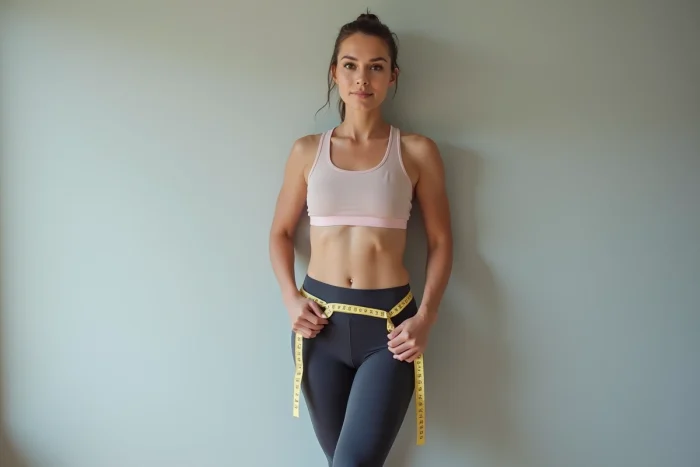
Fat mass and measurement tools more precise than BMI
Technologies such as bioelectrical impedance analysis (impedance scale) or dual-energy X-ray absorptiometry (DEXA) directly measure body composition: percentage of fat mass, muscle mass, bone density. These tools provide a much more complete picture than the weight/height ratio.
Bioelectrical impedance analysis is now accessible via consumer scales, although reliability varies by device. DEXA, used in hospital settings, remains the reference for accurately quantifying fat distribution. Direct measurement of fat mass exceeds the precision of any formula based on weight and height.
When to consult a doctor to assess weight
An online calculation provides an indication, not a verdict. Consulting a doctor or nutritionist becomes relevant in several situations:
- A BMI below 18.5 or above 30, which corresponds to the thresholds of underweight or obesity defined by the WHO.
- A rapid weight gain or loss without voluntary changes in diet or physical activity.
- Family history of diabetes, cardiovascular diseases, or eating disorders.
- The menopause period, where fat redistribution justifies appropriate monitoring.
The weight displayed on a scale says nothing about a person’s actual health. Height, age, body shape, and bone structure modify the reference number by several kilograms depending on the formula used. Cross-referencing at least two indicators (BMI and waist circumference, or BMI and bioelectrical impedance analysis) provides a more reliable estimate than an isolated calculation.