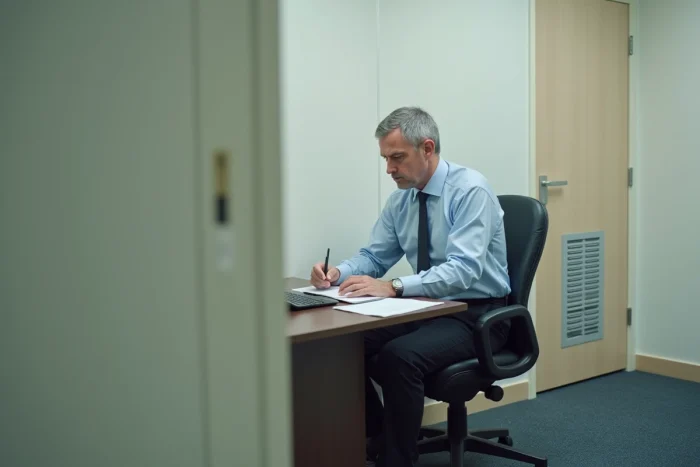
Working within four opaque walls, without a trace of light from outside: no law explicitly prohibits this scenario in France. However, the Labor Code does not spare the requirements. Every professional space must be bathed in sufficient natural light, unless the configuration of the premises makes this requirement unachievable. In this case, the exemption comes with strict measures, under the attentive supervision of occupational health services. Artificial lighting cannot therefore be installed lightly.
On the ground, inspections by the Labor Inspectorate regularly highlight violations of lighting and safety regulations. The consequences are not limited to administrative sanctions: the absence of natural light weighs on the health and efficiency of employees. For any office layout project, compliance is not up for discussion; it is an obvious necessity to respect, under penalty of jeopardizing the balance of the entire team.
Working in a windowless room: what French regulations say
The layout of professional spaces adheres to specific guidelines. According to the Labor Code, each workstation must benefit from what is termed “sufficient” natural light, unless the structure of the premises allows for no openings. The absence of a window does not give the employer a free pass: they must compensate for this lack with appropriate measures. This includes installing effective artificial lighting, regularly checking its efficiency, and arranging workstations to limit visual fatigue.
The fact of working in a blind room raises questions about the safety and welfare of employees. Before any assignment in a windowless space, the employer must meticulously assess the risks: air quality, lighting levels, access to emergency exits. The standards related to fire safety and accessibility allow for no approximation. It is impossible for the employer to evade demonstration: they must prove that the absence of natural light does not endanger the health of workers.
Here are the most significant obligations to respect in this context:
- Lighting: maintain a minimum of 300 lux at the workstation, with regular readings and checks.
- Ventilation: ensure air renewal complies with the NF standard.
- Risk prevention: seek the opinion of the CSE and the occupational physician before any installation in a blind room.
Case law leaves no room for chance: it reminds us that the comfort threshold depends on the type of activity, and that each workstation must undergo rigorous evaluation. The layout must be based on concrete evidence, light readings, documentation on the absence of alternatives, and adaptation of lighting devices. For more details, the article “working in a blind room” provides comprehensive insight into this regulatory issue.
Absent natural light: what risks for health and well-being at work?
Working in a windowless space is not just a temporary inconvenience. Medically, the occupational risks accumulate, impacting the health and motivation of employees. Daylight regulates our biological rhythm. When it is lacking, the body struggles to maintain its bearings: fatigue sets in, mood fluctuates, and sleep disturbances multiply. To avoid these issues, a precise assessment of occupational risks is essential from the outset of the layout.
Studies by INRS and ANSES confirm tangible effects on visual health. Artificial light, if poorly dosed or poorly distributed, promotes eye strain, headaches, and decreased concentration. The human eye is not designed to endure entire days under fluorescent lights. Added to this is a sense of confinement, particularly pronounced in blind rooms where air circulation is difficult.
To better understand the concrete effects, here are the main risks to monitor:
- Visual fatigue: the need to adjust lighting to reduce eye strain.
- Psychological risks: isolation, anxiety, loss of sense of time.
- Sleep regulation: disruption of circadian rhythm, diminished alertness.
In the workplace, prevention is not limited to an administrative formality. It is about protecting the health and safety of employees by integrating the psychological and physiological dimensions of lighting. Support and regular adjustment of working conditions then become priorities.

Designing a compliant and pleasant blind space: practical solutions and obligations to know
When it comes to occupying a room without openings, vigilance must be at its peak. The Labor Code tolerates the existence of blind premises, but strictly regulates their organization. The use of artificial lighting then becomes essential, with a constant and sufficient light level, without shadowy areas or glare. The NF X35-103 standard imposes a threshold of 300 lux for administrative tasks, adjustable according to the precision required by the activity.
The employer must opt for solutions tailored to the configuration of the premises. To come as close as possible to visual comfort, it is advisable to choose LED fixtures with a neutral color temperature (between 4000 and 5000 kelvins), which replicate daylight. Harsh contrasts should be avoided to limit eye strain. The ideal: multiply light sources and distribute them evenly.
To ensure compliance with standards and improve comfort, several practices can be implemented:
- Regularly check the light intensity using a lux meter to ensure compliance with regulatory thresholds.
- Opt for light tones on walls and furniture, which diffuse and amplify light.
- Encourage frequent breaks to preserve the visual health and alertness of employees.
Introducing green plants or a few natural decorative elements helps soften the atmosphere and partially compensate for the absence of windows. Before any layout, it remains essential to conduct a specific risk assessment for the room in question. This process, led by the employer, involves all stakeholders, including employee representatives and occupational health services, so that prevention becomes a shared responsibility.
At the end of the corridor, behind a door without a view, the challenge is clear: to transform a blind space into a livable workplace, without ever lowering the guard on the health and rights of everyone.