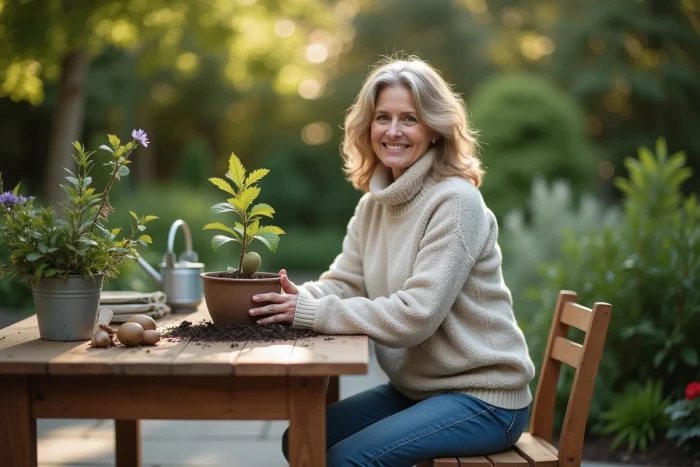
An acorn in the palm of your hand does not herald any prowess. Yet, behind this unassuming shell, everything can change: a simple chance fruit can give rise to a sturdy tree or, conversely, to a stubborn, frail subject ill-suited to living in miniature. The oak, true to its reputation, does not bend easily: its taproot remains tenacious, almost rebellious to the bonsai format, and offers no ease to those who wish to tame it in a pot.
Nothing is done halfway on this path where the acorn becomes a miniature tree. Every parameter—season, selection, soil freshness—counts. Winter immediately imposes its law: without a cold period, there is no germination, just a suspended time that leads to nothing. Navigating between excess water and suffocating substrate, seizing the slightest trace of life over the weeks, requires steadfastness and consistency. From the first handful of fresh soil to the first spring leaves, every advance demands rigor and finesse.
Why choose an oak for bonsai: advantages and peculiarities
Choosing the oak for bonsai cultivation is aiming for a strong presence. Varieties like robur, ilex, suber possess a natural stature, even when reduced to the extreme. Dense foliage, marked bark, powerful branches: in a pot, the oak loses none of its raw energy. Once settled in its container, it thickens, resists, and never falls into the fragility of appearance.
To create an oak bonsai from an acorn, one must accept the cyclical slowness of nature, follow the rhythm of the seasons, and demonstrate patience and diligence at every stage. There is no room for approximation: every manipulation influences the trajectory of the future miniature tree, from preparation to leaf pruning or trunk shaping. Over time, one obtains a compact, dense subject that retains the strength of the adult oak in its lines.
Transforming an acorn into a young oak bonsai: the major steps
Choosing and preparing the acorn
The choice and preparation of the acorn mark the true starting point. A few decisive steps punctuate this beginning:
- Take a perfect acorn: it should remain firm, healthy, without signs of spots or softening.
- Soak for 24 hours: only acorns that sink will do; those that float are discarded.
- Go through the cold stage: into the refrigerator, in moist sand, for at least a month. This dormancy mimics natural winter and awakens the seed to germination.
Sowing and germination: obtaining a vigorous seedling
After the cold period, sowing can begin. To maximize your chances, it is better to:
- Burrow the acorn 2 to 3 cm into a light, airy substrate enriched with sand to facilitate drainage.
- Maintain soil moisture with care, never over-saturate. A simple mistake can quickly be costly, leading to rot or growth blockage.
- Examine the taproot as soon as the first leaves appear: if it develops well, it’s time to transfer to an individual pot to control its growth.
Repotting and acclimatization to the pot
The repotting step should not be rushed under any circumstances: it is about giving the young subject every chance for the future. To achieve this:
- Choose a pot with drainage holes, equipped with a mesh for good aeration and to avoid root rot.
- Subtly trim the taproot: keep enough for vigor, but short enough to encourage branching on fine rootlets.
- Gradually introduce light: avoid too direct exposure at first, allowing the tree to regain its bearings before facing full sun.
In the early months, everything hinges on successive adaptations: growth speed, leaf condition, response to watering variations. Observing, adjusting, correcting tirelessly—that is the routine of the engaged beginner. This period sets the entire trajectory of the future bonsai.
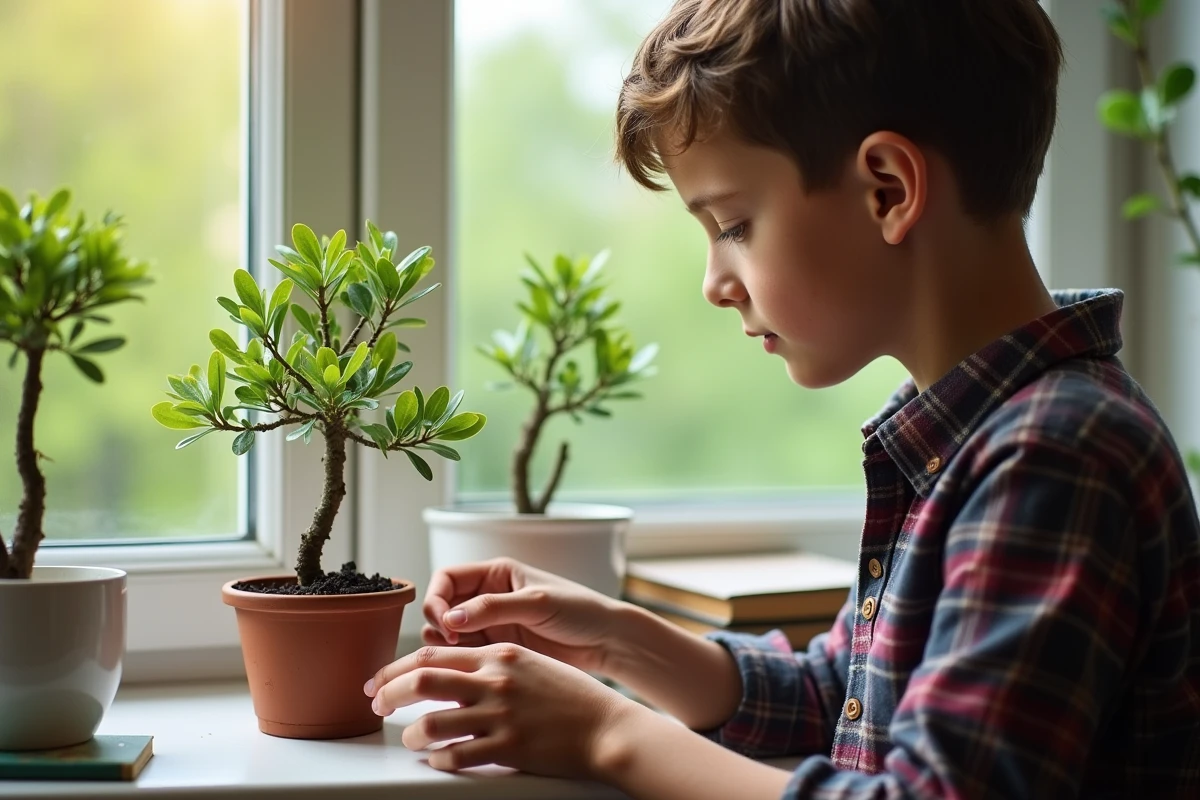
Caring for an oak bonsai: practices and mistakes to avoid
Watering, fertilization, pruning: aiming for balance
Watering requires meticulousness: wait for the surface to dry before intervening. Over-saturated soil quickly condemns the roots of the oak bonsai; conversely, letting it dry out for too long stunts its growth. Regarding fertilization, two applications: one in spring, another just before autumn, are sufficient to support vigor without encouraging unbalanced growth.
Shaping the form, avoiding missteps
In the realm of pruning, finesse makes the difference. Favor interventions on young shoots, regular and moderate, to give style to the trunk without losing its natural appearance. Using clean, well-sharpened tools remains a golden rule, as does setting up (and quickly removing) wiring to guide the structure without leaving marks on the bark.
To accompany development, keep the following guidelines in mind:
- Practice repotting at the end of winter, during the sap’s rest: this is when the oak manages this upheaval best.
- Avoid abrupt changes in temperature or light: weakened foliage can quickly deteriorate, even in just a few days.
Year after year, the oak bonsai takes shape. The trunk thickens, the branches assert themselves, the bark deepens, resembling a centennial subject captured at a reduced scale. Over time, every detail speaks of patience and balance. To see all this strength contained in a palm is to touch the profound promise of the miniature tree.