
A sharp pain under the lower ribs, which appears when bending or sneezing, then disappears without explanation. This scenario often leads to emergency consultations for a cardiac or digestive issue. In the majority of cases, the tests return normal. The culprit is sometimes a lesser-known bony structure: the floating rib, and more specifically the syndrome named after the English doctor Cyriax.
Floating rib and joint hypermobility: an underestimated link
The Cyriax syndrome is not limited to a local mechanical problem. The slipping of a rib and the compression of an intercostal nerve explain the pain, but they often occur within a broader context.
Several publications in rheumatology and pain medicine describe an association between slipping rib syndrome and joint hypermobility, including Ehlers-Danlos syndrome. In these patients, ligamentous fragility is not limited to the knees or shoulders. It also affects the chondro-costal joints, where the cartilage connects the rib to the sternum.
A person whose joints are naturally very flexible (thumbs touching the forearm, elbows hyperextending) has connective tissue that holds the lower ribs less firmly. The cartilage of ribs 8, 9, and 10 can then subluxate more easily, even without violent trauma. Sometimes, a simple trunk rotation movement is enough.
This link changes the management approach. A hypermobile patient treated solely with local manipulation risks recurrence. It is also necessary to understand the floating rib syndrome in its systemic dimension, by assessing overall ligamentous laxity and adapting rehabilitation.
Diagnosis of Cyriax syndrome: why it often takes months
Have you ever noticed that chest pain immediately triggers fear of a serious problem? It makes sense. The medical reflex is first to rule out a heart attack, pulmonary embolism, or digestive pathology. Standard tests (ECG, CT scan, abdominal ultrasound) return normal. The patient is reassured, but the pain persists.
The average time before diagnosis varies from several months to over three years according to published studies. This delay can be explained by two factors.
The first is anatomical. Ribs 8, 9, and 10 (the false ribs) do not articulate directly with the sternum. They are connected to each other by soft fibrous tissue. This area is rarely palpated during a standard clinical examination.
The second is cultural. The Cyriax syndrome is not well taught in initial medical training. Many practitioners do not spontaneously think of it when faced with unilateral thoraco-abdominal pain.
The hooking maneuver, a simple test
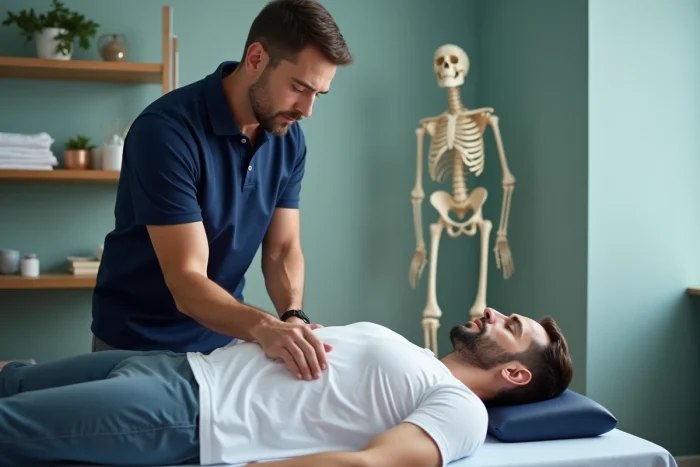
However, the diagnosis relies on an accessible clinical gesture. The practitioner places their fingers under the anterior costal margin and exerts a pull upwards and forwards. If this movement exactly reproduces the patient’s usual pain (sometimes with an audible snap), the diagnosis is made.
- The pain is unilateral, localized at the anteroinferior border of the thorax, sometimes radiating to the back or abdomen
- It increases with coughing, sneezing, trunk rotation movements, or prolonged sitting
- It can mimic gallbladder pain, nephritic colic, or intercostal neuralgia
Dynamic ultrasound provides a useful complement. It allows real-time visualization of the rib’s slipping during the maneuver, which objectifies the diagnosis and helps plan a targeted therapeutic gesture.
Relieving floating rib pain: from intercostal block to surgery
The management follows a progressive logic. Treatment always starts with the least invasive options before considering more invasive procedures.
Conservative treatments
Relative rest, anti-inflammatories, and physiotherapy constitute the first line. Strengthening the stabilizing muscles of the trunk (obliques, transverse, serratus anterior) aims to compensate for ligamentous laxity. In hypermobile patients, this muscle strengthening is particularly crucial to prevent recurrences.
Additionally, some therapists work on overall thoracic mobility, releasing tensions at the level of the posterior costo-vertebral joints. The goal is not to “put the rib back in place” (a misleading formulation), but to restore balanced respiratory and postural mechanics.
Ultrasound-guided injections
When pain resists first-line treatments, targeted injections represent an effective intermediate option. Specialized pain medicine teams report good results with ultrasound-guided intercostal blocks (injection of local anesthetic combined with a corticosteroid at the chondro-costal joint). Published series in Pain Physician and Regional Anesthesia & Pain Medicine describe a significant reduction in pain and analgesic consumption in the following months.

Surgery: resection or rib stabilization
Surgery is reserved for patients with significant disability, where all conservative treatments have failed. Thoracic surgery centers in Europe and the United States report overall satisfactory functional results after resection or stabilization of the pathological rib, with a clear improvement in quality of life.
However, it is important to mention a significant risk of residual or neuropathic chest pain after the procedure. This factor encourages not to rush into surgery and to exhaust alternatives first.
Physical activity and slipping rib syndrome: adapt without stopping
Complete cessation of sports is generally not necessary, except in the acute phase. Movements to temporarily avoid are those that heavily engage trunk rotation or thoracic compression: racquet sports, rowing, certain weightlifting exercises (heavy bench press, dips).
- Swimming (freestyle and backstroke) is often well tolerated as it mobilizes the thorax without compressive strain
- Isometric trunk strengthening (planks, core exercises) stabilizes the ribs without causing slipping
- Yoga or Pilates, practiced with a therapist informed of the diagnosis, improve thoracic proprioception
Gradually resuming while monitoring the pain threshold remains the rule. A well-managed Cyriax syndrome does not condemn one to inactivity. It simply requires understanding its mechanics to adapt daily and sports activities, rather than enduring recurrent painful episodes without explanation.